The Remembrance Report
26 years ago, trans activists in Boston organized the first Trans Day of Remembrance to mourn those we’ve lost and to demand an end to the violence against transgender people—particularly trans women of color. When Rita Hester and Chanelle Pickett were both lost in violent anti-trans attacks within a few years of each other, trans people came together to remember, to mourn, and to demand better for those who would come after them.
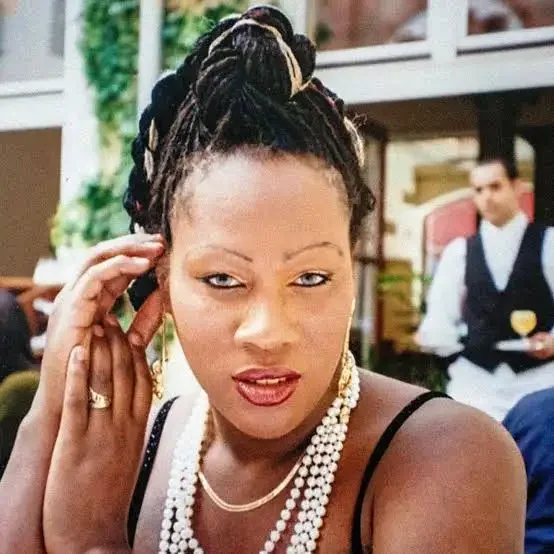
Rita Hester. Courtesy of Hester Family/The History Project.
Since the last Day of Remembrance, we lost two extraordinary trans elders: Miss Major Griffin-Gracy, 78, and Lady Java, at 82. They were legends who are already deeply missed, and their legacies will reverberate for decades to come. One important factor tempers our grief: Miss Major and Lady Java were each celebrated during their lives, as artists, organizers, and pillars of our community. They will never be forgotten.
Miss Major mentored generations of young trans people and fought to help trans women who had been incarcerated as the director of the TGI Justice Project. The Project strengthens trans, intersex, and gender-variant people for the fight against imprisonment, police violence, racism, and poverty, and seeks to create a world rooted in gender justice. Today, her daughters carry on her work all across the country. The film Major! and the book Miss Major Speaks: Conversations with a Black Trans Revolutionary both carry her indomitable spirit forward to inspire new generations.
Lady Java’s groundbreaking 1967 protest, when she fought against the Los Angeles cross-dressing laws which forbade her from working as a trans performer, was a major step forward in the nascent LGBTQI+ civil rights movement. It also didn’t stop her from leading a shining performance career throughout the 1960s and 1970s. In the 2010s, she reemerged into public life to make sure her story was told. She also lived long enough to consult on a future film about her life.
We will keep telling their stories. They should have stayed with us longer, but they portray what trans people everywhere should have—a rich and impactful life.
As we remember those lost to violence, we also grieve their stolen futures. Their stories shine through the words of their loved ones, who remember their passions for music and art; their love of partners, friends, and pets; their talents for community organizing or fashion or ballroom or journalism or computer science. As trans people, living openly as ourselves often requires immense courage—and that courage inspires others to live more fully and authentically. As one relative of Kelsey Elem, a 25-year-old Black trans woman from Missouri who we lost this year, said, “watching [Kelsey] grow into her confidence and share it with the world was a blessing.” When we lose trans people, everyone loses so much.
There are far too many whose names we’ll never know. What mark could they have left in history, or on the arts and sciences? What legacy could they have left behind of happy families and beloved communities before passing peacefully, surrounded by loved ones?
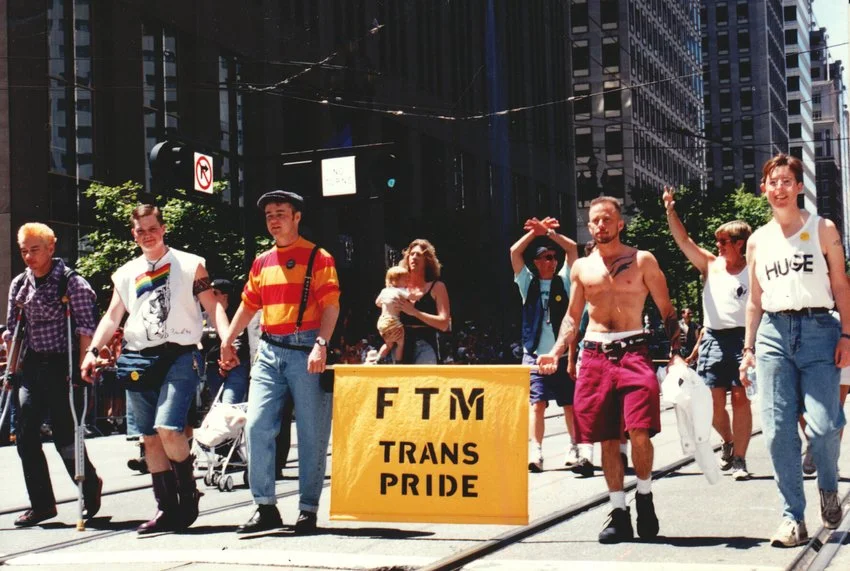
Trans men and their allies marching in the San Francisco Pride Parade in 1994. In the front row from left to right: Max Wolf Valerio, Matt Rice, David Harrison, Loren Cameron, and an unknown person. In the back row, from left to right: Susan Stryker (holding baby), Brynn Craffey, and Stephan Thorne. Digital Transgender Archive.
We are in an extraordinary moment in the fight for trans lives and greater gender freedom for all.
For the trans community and our allies, many of the vicious attacks threatened by President Trump's 2024 campaign have come to pass. Officials in the highest levels of our government are constantly spreading misinformation and lies about trans people, as well as directly calling for violence against us. This administration has attacked trans healthcare research and access, dismantled protections for LGBTQI+ youth in schools, censored the very mention of trans people from our nation’s history and federal resources, and much more.
This administration has aggressively targeted trans people, seeking to force the nation back to an imaginary time where people like us didn’t exist—where gender is a prison to cage us, instead of a canvas to express our true selves.
The erasure of our lives, experiences, and data is particularly harmful. Trans people in the United States have fought for decades, if not centuries, to live freely as ourselves, connect with each other, and access the resources we need. Until very recently, information about us was difficult to find. All too often, the stories of our loved ones were lost, and any record of their true selves were buried with them.
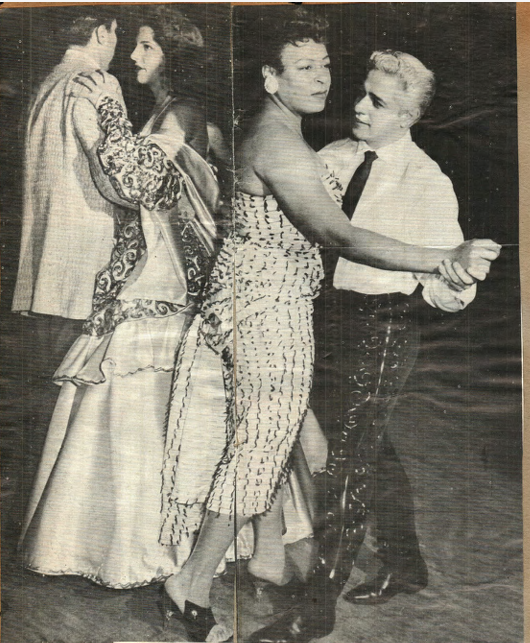
A trans man and trans woman dance at a Chicago drag ball. Digital Transgender Archive.
There’s a long history of trans people creating our own media, publishing newsletters and magazines to share information about everything from hormone treatments and supportive doctors to fashion tips and community gatherings. More personally, the Digital Trangender Archive hosts several scrapbooks made by transgender people, most of them trans women, who combed mainstream newspapers and magazines for any mention of people living cross-gender lives. These carefully preserved clippings include information about people who pursued gender-affirming surgeries in the 1950s and 60s, drag queens performing in front of cheering crowds, transgender men marrying cisgender women, and much more. These records feel both precious and sobering, reminding us that we’ve always been here while also showing how hard it was to be truly seen. Efforts like these are the ancestors of today’s community work to preserve the stories of those we’ve lost.
With the advent of the Internet, the lines of connection between us grew stronger. One 1990s ad in Transgender Tapestry magazine drew attention to “over 1,000 transgender internet sites.” Today, social media is both a powerful tool and a dangerous minefield. The final posts of one teenage trans girl, talented gaming artist Charlotte Fosgate, were viciously mocked online after her tragic loss from suicide. At the same time, we often rely on social media to share the stories of lost loved ones and pressure the authorities to remember them accurately.
Some trans writers are reckoning with the broader notion of “visibility.” What does it mean to tell your story, if that will lead to attacks from extremists who will then harass us online or get us fired from our jobs? We continue to navigate these risks as we fight to teach our history, remember those we’ve lost, and share our stories. As Miss Major said, “It’s our allies who need to be more visible. You can’t miss us.”
We are now organizing to survive under a government that is actively erasing information about our lives.
Valuable trans health data from the HHS and CDC has been either censored or taken offline, and research projects that even tangentially mention gender have been shut down.
Trans people have long recognized the need for data that truly reflects our community’s experiences and needs. The first major effort to document our community’s experiences began in 2008 and evolved into the U.S. Trans Survey—now the largest survey of trans people in the world. With over 92,000 respondents nationwide, the 2022 survey tripled participation from 2015. The growth of the survey, the bravery of those who answered it, and the deep data it provides about everything from employment and healthcare to civic engagement and family life all hold firm against attempts to erase us.
Black history has also been censored, especially as extremist politicians rip crucial lessons about race and culture from our schools. Black trans people’s stories are at particular risk of erasure, and their lives are at increased risk from violence. This year, we tracked 21 trans women lost to violence, most of whom were women of color. Out of the 17 trans women of color lost to violence, 15 were Black trans women.
30% of the trans women we lost were killed by intimate partners. Sam Nordquist, a Black trans man, was also tortured and killed by people he thought were his friends and partners. Trans individuals are 1.7 times more likely to experience all forms of intimate partner violence.
The intimacy of this violence is even harder to navigate when we are also being attacked relentlessly from the highest podiums in the land. Those who should love and protect us imbibe the same disinformation and harmful, bigoted stereotypes peddled by those in power.
This year, we’ve seen at least 32 bills in Congress that would ban gender-affirming healthcare. In the last three years, anti-trans rhetoric and legislation from state lawmakers has grown ever more extreme. Much like Trump’s executive orders, state-level bills aim to enforce rigid, binary, and scientifically inaccurate definitions of sex and gender. This expands the harm already done by Republican-controlled legislatures banning life-saving healthcare for youth, restricting access to public spaces and facilities, and attempting to criminalize drag performances—the same kind of laws that tried to forbid Lady Java from performing.
Failures of law enforcement repeatedly appear in the stories we collected this year. Two trans people, Linda Becerra Moran and Rick Alastor Newman, were shot by police. In Sam Nordquist’s case, whose murder sent shockwaves through the trans community, his mother Linda and sister Kayla repeatedly called the local police asking them to check on him. On at least two occasions prior to his death, they were ignored, and no wellness checks were performed. This is particularly painful given the extreme violence that Sam, known for his kindness, survived before his death.

Sir Lady Java with Redd Foxx as she protested for her right to work. Digital Transgender Archive.
Investigations themselves also often fall short. Cherilynne Gratton-Camis, the mother of Denver hairstylist Jax Gratton, was deeply frustrated by the months it took to even find her daughter’s body. She wrote, “I have been treated as a burden. I have been treated as a pain. I have learned of the pain of so many transgender people–especially transgender women. I have heard about the pain that transgender people experience daily from the police.” The U.S. Trans Survey found that 62% of respondents were “very uncomfortable” or “somewhat uncomfortable” asking for help from the police because of their gender identity or expression. Police must take the vulnerability of trans people seriously.
These attacks on our lives—both literal and legislative—must end.
Trans people deserve to live freely and authentically without discrimination. We deserve access to the resources we need to thrive and the ability to live without fear that the government will deny our existence, exclude us from public life, and put us in grave danger from extremists across the country.
As a performer in the 1960s, Lady Java’s mother would watch and worry from their window as she waited for her daughter to come home safely after performing in late-night shows. “She never knew when someone might kill me, or do something terrible to me,” Java recounted. She worried about Java’s visibility as a trans person, saying that “it’s such a hard life.” Java replied, “I know, Mother. But someone has to make it better.”
By The Numbers
Data is for 11/1/2024 - 10/31/25, with some overlap to capture those lost in October 2024 whose loss was not reported in time.
Reach out toremember@transequality.org for more information.
While we work hard to gather and analyze the fullest possible dataset, it is very likely that this list remains incomplete. Due to the nature of how these stories are reported and underreported, we can’t draw comparisons year-over-year. Trans identities are often poorly acknowledged in life and erased in death, and we have a long way to go before we have a completely accurate picture of our community’s losses.
Total Deaths: 67
Total Violent Deaths:
29
Total Deaths from Suicide:
26
Violent deaths by gender identity
Violent deaths by race
Gun violence appears over and over in our data. Out of 29 total violent deaths, 17 were due to gun violence.
A 2024 report from Everytown showed that between 2017 and 2023, sixty-three percent of gun homicides against trans or gender-nonconforming people were committed against Black trans women. In the case of Dream Johnson, a Black trans woman in Washington, DC, men shouted anti-trans slurs at her before shooting. It is likely that she was targeted, harassed, and killed because of who she was as a trans woman. In our data, out of 17 total Black trans people who were lost to violence this year, all but two - Sam Nordquist and Christina Hayes - were killed using guns. Safety from guns is a major need for the trans community.
Cause of death by gender identity
Cause of death by race
Cause of death by age range
61% of all those lost to suicide were trans youth ages 15-24
The Trevor Project’s latest study, released in October 2025, shows that younger trans and gender-nonconforming youth aged 13-17 are at particular risk for suicidal ideation and poor mental health outcomes. Discrimination and harassment, often targeted at trans women and girls, strongly affect mental health. Trans people who were verbally harassed, denied equal treatment, or physically assaulted were much more likely to experience suicidal thoughts.
On our list, 61% of those lost to suicide were between the ages of 15 and 24. As Danielle Dehoniesto, Kamora Woods’ mother, said, “Love your child. Accept your child for who they are, because life is too short. You don’t know what can happen.”
Total Deaths from Natural Causes:
10
Total Deaths from Unknown Causes:
2
Frequently Asked Questions
-
We received some reports by direct submission to remember@transequality.org and from several organizations listed in the acknowledgements section below. Many names and stories on our list come from our research, which includes news reports and social media monitoring, and the tireless work of many organizations, reporters, volunteers, families, and friends.
-
All members of our community deserve to be memorialized as their true selves. Some people experience a fixed gender identity, but it can also be a journey that some on our list were only beginning to explore or express. In addition to transgender and nonbinary victims, we also recognize two-spirit, māhū, khwaja sira, agender, and other identities beyond the gender binary, as well as those who are gender nonconforming, genderfluid, or intersex. Everyone’s story is unique, but every person on this list appeared to be trans, nonbinary, or gender-nonconforming.
There are also some people who we lost outside of our date range. In particular, both Aubrey Dameron and Jay Lee went missing over the last few years, and we only learned about what happened to them this year. They are not included in the numerical data here, but we have told their stories as part of our digital memorial at transremembrance.org. -
Violent deaths are those that occurred as a result of physical violence or an attack against a person. These include crimes like assault, homicide, or manslaughter. Apathy, discrimination, and unconscious bias from investigative agencies means that some deaths get investigated more vigorously than others, and some disappearances are taken more seriously than others. Since racism and transphobia are deeply ingrained in the criminal justice system, deaths resulting directly from law enforcement are categorized as acts of violence.
Acknowledgments
Eulogy by Bahari Thomas
Report and storytelling by Tekla Taylor
Website and design by Illyana Bocanegra
Digital support by Ella Chen
Thank you to all those who ensure that the memories and stories of our beloved trans community are told, including:
Dreams of Hope
Pittsburgh Lesbian Correspondents
Samantha Riedel
Orion Rummler
Lyon-Martin Community Health Services
The Trans Lives Matter Database
TRACTION
Youth MOVE National
The families and friends of all those we’ve lost.
We will never forget them. Let their memories light our way toward liberation.